

“Waltzing Matilda, Waltzing Matilda,
Who’ll come a-Waltzing Matilda with me?”
Everyone knows the words. Many people know that the Australian poet ‘Banjo’ Paterson wrote them. But how may people know the origin of the tune? In 1895 a young woman named Christina Macpherson sat down and played a marching tune she’d heard. ‘Banjo’ Paterson, who was visiting Christina’s brother, liked it and wrote the words of a song to it. That song was ‘Waltzing Matilda’ and this book is about its creation.
‘Banjo’ became famous, and so did ‘Waltzing Matilda’. But Christina’s part in the song’s creation was forgotten and she disappeared from history until the 1970s.
Come a-waltzing with Christina now and discover her story – beginning in the first year of her life, when she encountered the ruthless bushranger Dan Morgan…
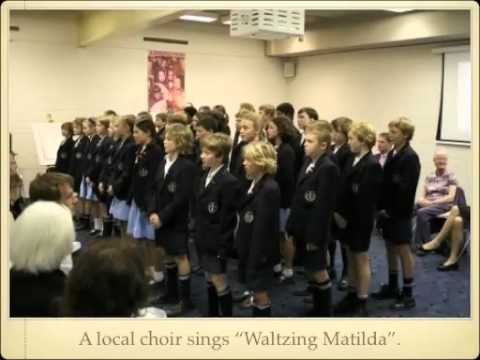
At the Melbourne Launch of Christina’s Matilda, with a choir from Year 6, Christ Church Grammar School, South Yarra, Australia singing “Waltzing Matilda”.
Links
Read more on Google Booksearch
Feature articles in The Age on the launch by Premier of Victoria, the Hon Ted Baillieu
Teachers’ notes (free download)
More samples of Elizabeth’s illustrations: Coroflot and Illos.net


IP (Interactive Publications Pty Ltd) –
“With Australia Day almost upon us, what better opportunity to review this fascinating title by Edel Wignell focussing on the story behind the story of our unofficial anthem, ‘Waltzing Matilda’? As Wignell asks, while most people can tell you who the author of the lyrics is why isn’t the composer of the tune just as famous? She then tells us the story of Christina Macpherson beginning with an encounter with bushranger Daniel ‘Mad’ Morgan at the family home of Peechelbar in Victoria, her childhood in a large wealthy Melbourne household, and her eventual meeting with A.B. ‘Banjo’ Paterson at the home of her brother on a station on the Diamantina River about 128km from Winton, Queensland. Evenings were a time for entertainment – Paterson sharing his poetry and Macpherson playing the piano, including a tune called “Craigielee” that she had heard at the Warrnambool Races some time before and which had stuck in her mind. Paterson was well aware of the plight of many shearers displaced by the Great Shearers’ Strike in 1894 and the stories accompanying the hardships they endured, and it wasn’t long before he penned the words of ‘Waltzing Matilda’ to fit the tune. Wignell then traces the story of the song through to its place in the Australian identity today, including the work of Richard Magoffin who relentlessly tracked the song’s origins, eventually being able to identify Christina’s contribution in 1983.
The story is accompanied by a variety of illustrations including paintings and drawings, maps, photos, posters and programs, letters and sheet music, each adding to the authenticity of the story and providing insight into the times that inspired the lyrics and the history of the song. Perhaps the most interesting is a facsimile of an extract from a letter from Christina which explains how the song came to be. Each sepia page is bordered with exquisite line drawings by Elizabeth Botté which enrich and enhance the story.
While it is written in a style and language accessible to a newly independent reader, its use of primary sources to support the text would be a great way to introduce the importance of these sorts of sources to support research and provide evidence, an integral element of the historical skills strands of the Australian History Curriculum for Year 7.
This is a resource that needs to be on library shelves and a story that needs to be known by everyone old enough to sing the song!”
– Barbara Braxton, Librarian Teacher
IP (Interactive Publications Pty Ltd) –
“Who was Christina Macpherson and what was her connection to the famous ‘Waltzing Matilda’?
The front endpaper reveals to the reader the historical nature of the story. The paper resembles an old, faded book and the maps orient the reader to
places that are significant. As you turn the pages of this beautifully presented book, the story of Christina Macpherson’s life slowly unfolds. The illustrations are beautifully detailed combining paintings and drawings, maps, photos, posters and programs, letters and sheet music.
In 1895 while Banjo Paterson was visiting Christina’s brother, Christina played a marching tune that she had heard the previous year and Banjo Paterson composed words to go with the tune. Significantly, the song was neither copyrighted nor published at that time. However, when the song was published several years later to promote Billy Tea, a few words were changed and the musical arrangement was credited to Marie Cowan. She did not claim to have arranged the tune, but at that time Christina’s
contribution was not known. It took many years before the historian and bush balladist, Richard Magoffin discovered Christina’s contribution to this famous Australian song.
Reading the story of Christina’s Matilda is like looking through an old scrapbook, faded with time with sepia coloured pages with beautiful borders; pages that are filled with personal memorabilia that tell a fascinating story and shed light on the origins of ‘Waltzing Matilda’.”
– Margaret Warner, Buzzwords
IP (Interactive Publications Pty Ltd) –
“Everyone knows the song “Waltzing Matilda”, but how many people know the true story behind its creation?
Christina MacPherson, playing a marching-band tune was the girl who originally inspired Banjo Patterson to write his song while Banjo was visiting her brother.
Though the old Scottish tune and the lyrics are remembered, Christina’s part in the story was forgotten until the 1970s. Christina’s Matilda, written by Edel Wignell and illustrated by Elizabeth Botte brings Christina’s story to life.”
– Dee White, Kids Book Capers
IP (Interactive Publications Pty Ltd) –
“This is an excellent resource for those interested in knowing where our unofficial anthem, Waltzing Matilda comes from, who wrote it, and what exactly does the narrative within it mean. There are historical photographic portraits of the main players, Christina Macpherson (whose family was held up by the bushranger Dan Morgan), and Banjo Paterson (who penned the words at a dinner table because he liked the tune. It was Christina who, in 1894, at the age of 29, visited the Warrnambool races and heard a Scottish ballad, which became the bones of the song. After the death of her mother, Christina took the epic journey from Melbourne to a remote cattle station in Queensland to be with her family, and there she entertained Banjo Paterson with the tune. Apparently he was interested in the stories of swagmen as he toured the property, and it was one of these stories that found its way into the song lyrics.
The song has since then had many lives, sometimes as a commercial ditty for Billy Tea, as a traditional song taught to school children across Australia, and in the mid twentieth century with an entire new melody attached to it. As time passes, discussion continues over which tune it is we sing to our great poet’s ballad. Both sheet music versions are here for readers to use. A gem of a book for all ages, especially those beginning to see that history is a demanding and stimulating discipline. Recommended for historians or musicians from 8 to 18 years old.”
– Kevin Brophy, Reading Time
IP (Interactive Publications Pty Ltd) –
“This is an extended story of the woman who, by playing a march based on an old Scottish ballad in the hearing of a bush poet who was composing a set of verses, helped create one of the best known Australian songs of all time.
The real strength of this book lies in the retelling of historical events within the context of an ordinary life, kept alive through family history. Wignell has an engaging style which keeps the whole as one narrative. As with all family histories, there are necessary asides and qualifications, but it is overall a successful portrait of late 19th century colonial life for young readers.
The question of acknowledgment of contributions to a work of art, like a song, forms an interesting subtext for the child reader to think about too. The design of the book makes the most of the reproductions of photos, sheet music and other historical documents, with sepia colouring and charcoal drawings by Botté linking them all together. (The National Library of Australia being cited as the source of many of these items may lead readers to their excellent site on this topic.)
As they become more prevalent, I have finally found a word that I can use for the information book in picture book form: facture. These books are taking the place of conventional nonfiction publishing for children, as it wilts under the assault of Googling, and this is a particularly engaging example.”
– Margaret Robson Kett, Magpies
IP (Interactive Publications Pty Ltd) –
“In this delightful book Edel Wignell tells the story about Christina Macpherson. This little-known woman introduced Banjo Paterson to the tune which he used to accompany his words to create Australia’s most popular song.
Christina’s story is full of interest. There is an exciting account of a
rather dangerous meeting which her family had with the bushranger Dan Morgan. Christina was only a baby when this occurred. We learn of her education at a Ladies’ School in Melbourne. We are told of the events which led to her familiarity with a marching tune. This melody would inspire her famous musical setting for Paterson’s words. How she came to be at Dagworth Station in Queensland and meet Paterson is also revealed.
We learn of the depressed economic situation which played a part in inspiring Paterson’s words. We discover that there was more than one version of Waltzing Matilda.
While setting the historical record straight by acknowledging the
importance of Christina’s contribution, the book also includes archival photographs of those who appear in the narrative and the places mentioned. There are copies of the different Matilda versions for the reader to compare and maps to locate where events took place. A comprehensive glossary is provided at the end of the book. As a former teacher, I found the educational possibilities for individual or group research work are clearly obvious.
The sepia tones of each page made me feel that I was stepping back into the past to gather the information. I hope the imagination of younger readers will respond in a similar way.
Elizabeth Botte’s beautiful, intricate and intriguing line drawings which surround most of the page borders further promote one’s desire to explore and discover.
Édel Wignell has successfully told the story of a modest woman who made a very significant contribution to Australia. The young and not so young reader will find it a most worthwhile read.”
– Jim Low, Simply Australia
IP (Interactive Publications Pty Ltd) –
“Christina’s Matilda would certainly be a great resource for a school project and a great discussion piece for the classroom.”
– Angela Hall, Bug in a Book
IP (Interactive Publications Pty Ltd) –
“Everyone knows (or should know) who wrote the words to Waltzing Matilda – Banjo Paterson. But who wrote the music?
Christina’s Matilda is the story of Christina Macpherson, a woman born to a wealthy family in Victoria in 1864. Her story isinteresting, not only in relation to the famous song but her family were the last people to be held to ransom by Mad Dog Morgan.
When Christina’s mother died, she moved up to Queensland to be with her brothers and father on their large property, Dagworth. In the early 1900’s Christina met up with an old school friend, Sarah Riley who was engaged to Banjo Paterson. They spent many evenings entertaining with songs and poetry and readings.
Over the course of one such evening Christina played a tune by ear that she had heard at a race and Banjo started to write the words. The two spent the evening collaborating and ended up with the first verse of Waltzing Matilda.
But Christina was not recognised as the original composer when the publisher organised for another woman, Mary Cowan, to create a tune to go to the words. It wasn’t until 1983 that Christina Macpherson was acknowledged for her part in the history of the song.
This is a fascinating story where the use of historical photographs brings the story of the swagman to life. Australia has a wonderful and colourful history and Christina’s Matilda is a great book to read, to look at, and to learn from.”
– The Reading Stack
IP (Interactive Publications Pty Ltd) –
“The intriguing story of Christina Macpherson who in 1895 played a marching tune for her brother’s guest, one ‘Banjo’ Paterson, who liked the tune so much he wrote a song to fit it – Waltzing Matilda! The march, ‘Craigielee’, was arranged by Godfrey Parker, based on an old Scottish ballad.
An unknown & fascinating piece of Aussie history, lusciously presented in sepia tones with archival photos as a non fiction, large format hardback for mid to upper primary.
Should be in every school library around Australia.”
– Krista Bell, ABC Western Queensland